CCNA 200-301 Study Roadmap: Labs, Practice Exams, and a Supportive Community
The CCNA 200-301 is the single most valuable foundational certification a network or systems engineer can earn, and it remains the credential that recruiters filter for on every junior-to-mid networking role. It's also the exam where the largest number of well-intentioned candidates burn out around week four. Too much theory, not enough hands-on, and almost no time spent on the topics the exam actually punishes you on. This roadmap walks the practical path: what's tested and at what weight, the concepts that buy the most marks per hour, a ten-week plan that fits around a full-time job, the lab tools that move the needle, and the practice routine that turns rote memory into the kind of intuition the exam rewards.
Exam quick facts
Get the format clear before you commit study time. The CCNA 200-301 is a single 120-minute exam covering six domains. You'll see roughly 100 to 120 questions: mostly multiple choice, a meaningful number of drag-and-drop, and a handful of scenario-style items that present a partial topology and ask you to identify the misconfiguration or the missing line of config. Cisco no longer publishes the exact pass mark, but historically it's sat around 825 out of 1000 — treat 82 percent as your working target. The exam costs roughly USD 300, has no formal prerequisites, and is delivered at Pearson VUE test centres or online with a proctor. There is no penalty for guessing.
What's actually on the exam
The 200-301 blueprint splits cleanly into six domains, and the weightings are stable across recent revisions: Network Fundamentals at 20 percent, Network Access at 20 percent, IP Connectivity at 25 percent, IP Services at 10 percent, Security Fundamentals at 15 percent, and Automation and Programmability at 10 percent. Two practical takeaways from that breakdown. First, IP Connectivity is the single largest domain — if your OSPF or static-routing intuition is shaky, you cannot pass this exam by being strong everywhere else. Second, Automation and Programmability is only 10 percent but it's the section nearly every traditional networking candidate underprepares for. A handful of well-answered automation questions can swing a borderline pass into a comfortable one.
The high-leverage topics to master
Treat the rest of this section as your priority list. Depth here buys far more marks than breadth.
Subnetting until it's mechanical
If subnetting is not instant, you will lose time you can't afford to lose. Get to the point where you can compute network address, broadcast address, host range, and subnet mask for any /n in under fifteen seconds, on paper, without a calculator. The exam embeds subnetting inside other questions — an ACL, a static route, a VLSM design — so slow subnetting compounds. Drill thirty questions a day for the first two weeks until it becomes muscle memory, then refresh once a week for the rest of your prep.
VLANs, trunking, and EtherChannel
The Network Access domain is twenty percent of your mark and it is almost entirely VLANs, 802.1Q trunking, voice VLAN behaviour, EtherChannel (PAgP and LACP), and a working knowledge of STP — including which port goes into which state, why, and what changes when you flip the root bridge. Expect at least one drag-and-drop where you match STP port states to a topology. Build the topology in Packet Tracer until you can configure a three-switch trunked environment from memory.
OSPF single-area
Multi-area OSPF is out of scope for 200-301, but single-area OSPFv2 is in scope and tested deeply. You need to be fluent with neighbour adjacency states, DR/BDR election, the contents of the LSA types you'll encounter at a single-area level, and the show commands that diagnose a broken adjacency (mismatched timers, mismatched area, mismatched authentication, network mask mismatch). Static routing also appears — know floating static routes and recursive lookup cold.
ACLs and the Security Fundamentals you'll actually be tested on
Standard versus extended ACLs, named versus numbered, the implicit deny at the end, where to place each type for efficiency — all standard fare. On the security side, Cisco emphasises port security (sticky MAC, violation modes), DHCP snooping, dynamic ARP inspection, and the basics of AAA with RADIUS and TACACS+. You do not need to be a security engineer; you need to recognise these by name, know their purpose in one sentence, and configure the two or three you'll see in a scenario.
IP Services: DHCP, NAT, NTP, QoS basics
Only ten percent of the mark, but cheap to master. DHCP server and relay configuration, the four-message DORA handshake, static NAT, dynamic NAT, PAT (overload), and a passing familiarity with NTP modes and QoS marking versus queuing. None of this is conceptually hard — the questions punish carelessness, not understanding.
Automation and Programmability — don't skip it
The newest and most ignored domain. You need to recognise REST API request structure, the difference between JSON and YAML at a glance, what a Python script versus an Ansible playbook does at a high level, the role of controllers in SDN, and the broad strokes of network automation tools (Ansible, Puppet, Chef). You will not be asked to write code. You will be asked to read a small JSON blob and identify a field, or pick which configuration management tool is being described. Two evenings of focused study covers this whole domain.
Lab work that actually counts
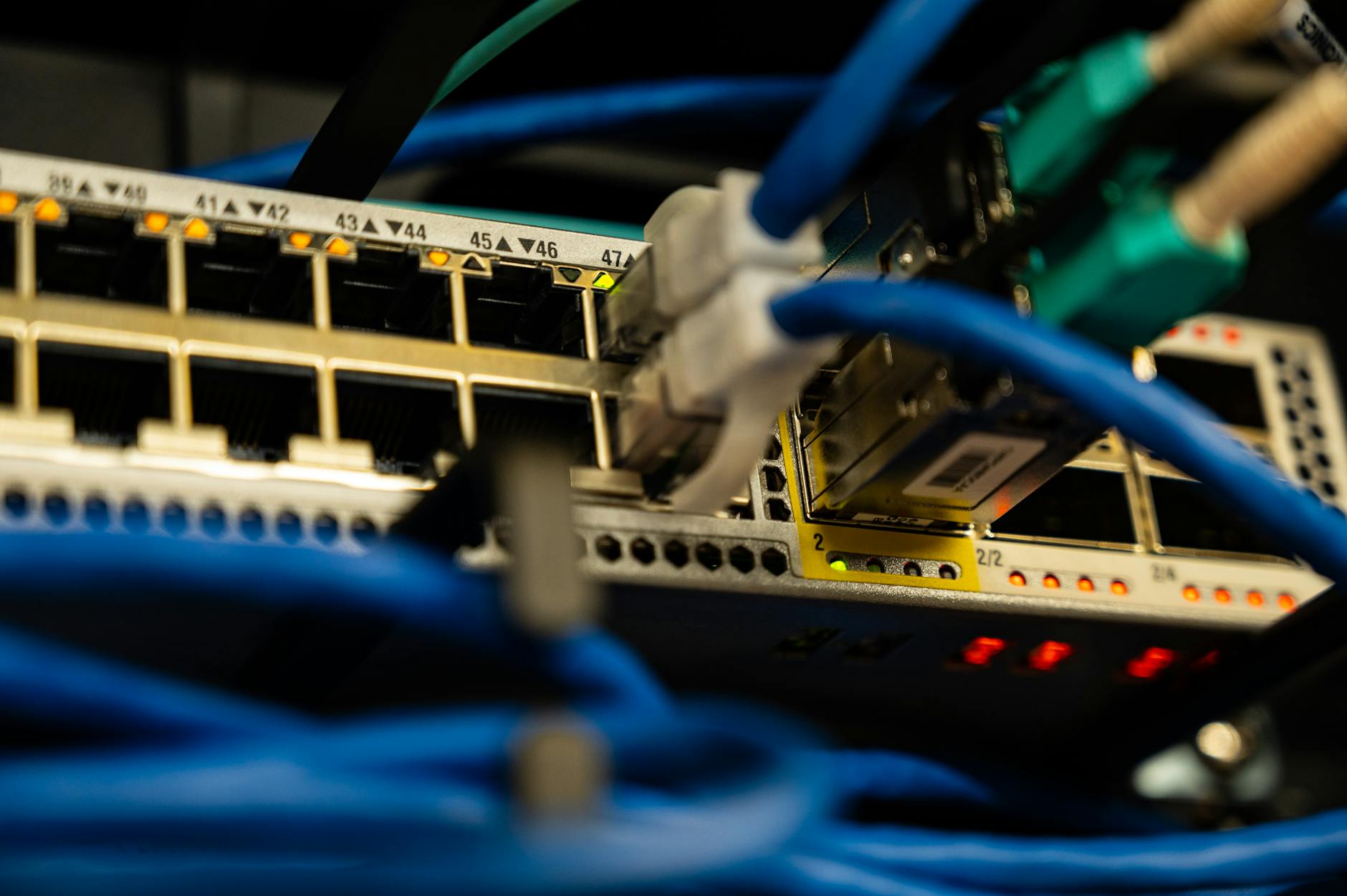
Three tools, in order of importance for the exam: Packet Tracer, Cisco Modeling Labs (CML) Free Tier, and GNS3. Packet Tracer is free, lightweight, and covers every topology you need to drill the exam. Build a lab where two switches connect to two routers, configure trunking, OSPF, an ACL, and DHCP — that single lab covers about half of your IP Connectivity and Network Access topics. CML gives you real IOS images and is closer to production reality; useful for the last two weeks when you want to validate your reflexes. GNS3 sits between the two; pick it up only if Packet Tracer feels constraining. The trap to avoid: spending six weeks building elaborate labs and one week on practice exams. Labs build understanding, but the exam rewards pattern recognition that only practice questions develop.
A realistic ten-week study plan
Weeks 1 to 2 — Fundamentals and subnetting. OSI and TCP/IP models, cabling, IPv4 and IPv6 addressing, and subnetting until it is mechanical. Thirty subnetting questions a day, every day, for the full two weeks. By the end of week two you should answer any /n subnetting question in under twenty seconds.
Weeks 3 to 4 — Network Access. VLANs, trunking, voice VLAN, EtherChannel, and STP including RSTP behaviour. Build a multi-switch lab in Packet Tracer and configure the whole thing from scratch three times. Take a topic-focused mock at the end of week four.
Weeks 5 to 6 — IP Connectivity. Static routing including floating statics, single-area OSPFv2, neighbour-adjacency troubleshooting, and the show commands that diagnose every common break. This is the heaviest single domain — give it the most time.
Week 7 — IP Services and Security Fundamentals. DHCP, NAT/PAT, NTP, QoS basics, then port security, DHCP snooping, dynamic ARP inspection, and AAA. End the week with a 60-question mock weighted toward weeks five through seven.
Week 8 — Automation and Programmability. Two evenings on REST APIs and JSON, two evenings on configuration management tools and SDN concepts. Light week deliberately — you are giving your earlier topics time to consolidate.
Weeks 9 to 10 — Full-length practice exams and weak-area drilling. Three full-length 120-minute mocks under exam conditions, spaced two to three days apart so you have time to review every wrong answer the same day. Your last mock should be within three days of the real exam, and you should be hitting 85 percent or higher consistently before booking.

Exam-day tactics that move the needle
First, read every question to the end before you look at the answers. Cisco loves to bury a single qualifier — "the most efficient", "the first step", "not" — that flips the correct answer. Second, flag and move on. Spending six minutes on a single drag-and-drop will cost you three later questions you could have answered in ninety seconds each. Third, when you're stuck between two answers in a scenario question, read the topology diagram one more time — the answer is almost always something you can verify directly from the diagram. Fourth, never leave a question blank. There is no negative marking, so a guess on a flagged question at minute 118 is strictly better than a skip.
How IT Exam Certs helps you pass CCNA 200-301
You can read the official guide cover to cover and still fail this exam. The only reliable way to lock in 82 percent is to drill hundreds of exam-style questions, review every miss until the wrong answers stop being tempting, and run timed full-length mocks until the format itself stops costing you marks. That is what our CCNA 200-301 question bank is built for. Three things make it worth your time:

1. A 1,304-question bank sorted by Cisco's exact domains. When your week-four mock tells you OSPF is weak, you don't wade through a mixed pool — you click into the matching domain page and drill straight into it. The domain breakdown matches the official blueprint:
- Network Fundamentals — OSI/TCP-IP, IPv4/IPv6, cabling, the foundation every other domain depends on
- Network Access — VLANs, trunking, EtherChannel, STP and RSTP behaviour
- IP Connectivity — static routing, OSPF single-area, neighbour-adjacency troubleshooting
- IP Services — DHCP, NAT/PAT, NTP, QoS basics
- Security Fundamentals — port security, DHCP snooping, AAA, the security topics actually tested
- Automation and Programmability — REST APIs, JSON, SDN, the domain candidates most often underprepare for
2. Full-length timed exam simulations. 120 minutes, 100+ questions, the same domain mix as the real paper. Running three of these in your last two weeks is the closest you can get to the real conditions without paying for a retake. The simulator scores you per domain so your final revision can target the exact area where you're still leaking marks.
3. Explanations that teach, not just grade. Every question is paired with a written explanation that walks through why the correct answer is correct, why each distractor is wrong, and which Cisco concept the question is really testing. You learn the framework while you drill, which is far more efficient than re-reading the guide after each mistake.
If you're at the start of your prep, go to the CCNA 200-301 cert page, pick the weakest domain on your self-assessment, and drill 20 questions there before doing anything else. You'll know within an afternoon whether your study plan needs to lean harder on switching, OSPF, or the automation domain — and that single decision is worth more than another week of passive reading.
Final word
The CCNA is not a memory test, it's a fluency test. The candidates who pass are not the ones who read the most pages — they are the ones who put in enough hands-on time that show running-config feels like a reflex, and enough practice questions that Cisco's question style stops surprising them. Spend the weeks on the high-leverage topics above, drill consistently against the question bank, and treat your last three mocks as the real exam. Do that, and 825 out of 1000 stops being a target and becomes a floor.
Photos from Pexels: cover by Christina Morillo, ethernet switch by Brett Sayles, terminal by Rafael Minguet Delgado, study session by Andrea Piacquadio.